




Cabbage
Cabbage
Brassica oleracea Capitata group, ‘Poor man’s medicine chest’, ‘Colewort’
A freshly cut cabbage from your own garden, scrunched raw in coleslaw, steamed or stir-fried can transform the years of culinary mis-treatment that this robust vegetable has suffered. Cousin to broccoli, cauliflower and kale, cabbages are reliable growers and can reward a few moments’ time and energy with a rich rosette or dense head of lush leaves without too much fuss.
Cabbage consumption is associated with reductions in colon cancer, increased immunity and anti-bacterial properties. It is a useful source of vitamin C and beta-carotene both important immune boosters. Raw cabbage is said to be high in folic acid which is vital for healthy production and maintenance of new cells.
My three boys became interested in growing cabbages when I told them they could plant a vegetable that would grow as big as a football – once it is ready, the trick is to cut it before they can kick it!
In a nutshell
- Full sun
- Rich fertile soil
- Plant as seedlings
- Needs space
- Eat raw or cooked
Quantity
1 plant per person
Companions
- Mint
- Sage
- Rosemary
- Thyme
- Onion
- Garlic
- Peas
- Celery
- Potato
- Broad beans
- Beetroot
The growing lifecycle

Cabbage seedlings in punnets

Newly planted cabbage seedlings taking root

Cabbage seedling starting to grow

Cabbage seedling

Cabbage seedlings starting to head up

Savoy cabbage plants crowding a bed with lush leaves

Red cabbage with developing head

Red cabbage

Red cabbage ready for harvest

Savoy cabbage ready for harvest

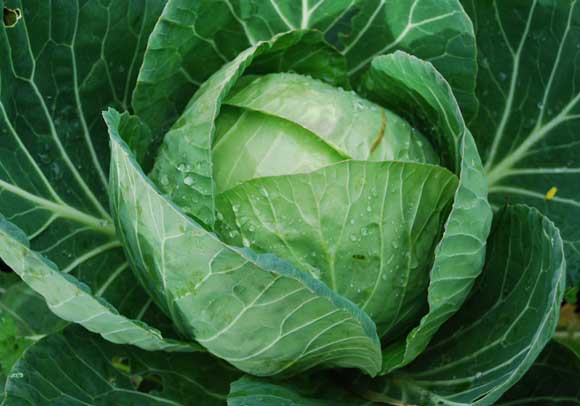
Perfect cabbage head

Yum yum!
Top 3 varieties
1. Red Jewel
Red varieties are said to be highest in anti-oxidants and can be cooked to keep colour when a little vinegar is added to cooking water. Smaller than other varieties can be grown for a harvest from summer through to late autumn.
2. Copenhagen Market
Good for smaller gardens with a tight and tasty ballhead. Grow through summer.
3. Vertus Savoy
For superior coleslaw and scrunchy stir-fries. Prefers cooler temperatures.
Getting started
When
Sow under cover in late winter for a summer harvest. Sow in spring for a winter harvest. Sow in summer for spring cabbages the following year.
Where
Cabbages need a place where they can grow un-molested for a couple of months. Best if they get direct sunshine so they don’t grow on an angle and end up lean and lanky rather than squat and chunky.
Soil
Cabbages are a little bit greedy and, like other brassicas such as broccoli, and kale, they grow best in rich, well-composted soil that does not hold onto moisture for more than say half a day. Ideally, they should be planted where peas or beans have previously grown so that they can take advantage of all the nitrogen that has been ‘fixed’ into the soil. Soil should be fairly firm so pat down with a rake after digging. This helps them establish strong roots to support that big head.
Sow & plant
Sow
I generally buy seedling plants but you can sow seeds into trays or punnets and plant out your own seedlings after about 5 weeks.
Plant
Seedlings should be planted out when they have six or so leaves and look like they are well-rooted and stable in their punnets. To test this, they should stand rather than flop over when you brush the back of your hand against them. Allow about a forearm by a forearm’s space (ie a square that is about the length of a forearm on each side) on the surface of your bed for each seedling (check seed packets or seedling labels as spacing does differ between varieties). Use two fingers or a trowel to make a small hole that is deep enough for the soil to bury the stem to the point where the bottom set of leaves are attached to it. Gently firm the soil around each of your seedlings to ensure good contact with roots.
Maintain
I use a hoe to gently keep those early spring weeds down – be careful not to go too deep or too close to your cabbage plants or you might damage roots. In dry weather it is important to see that your plants get at least a quarter of a watering can every two days. Once the heads start to form you can get out your liquid feeds – something with a good dose of nitrogen in it like liquid seaweed or worm juice is good. Give your plants a watering can of diluted feed every two weeks to boost growth.
Keep your seedlings well mulched and weed-free as they grow and develop. As with other brassicas make sure you keep firming the soil at the base of your plants.
Caterpillars from Cabbage White butterflies can be quite destructive so take whatever measures you think best to protect your crop.
Harvest or pick
Cut your cabbages just below the head but don’t pull the stems up straight away. If you make a cross cut on the upward-facing cut face of the stem you may find mini-cabbages form over the next few weeks.
Whenever you harvest is generally a good time to think about planting more – unless this interferes with your crop rotation.