




Currants
Grow
Ribes rubrum
Currants are small, tangy, cold climate treats, their sweet, sharp-flavoured berries are the number one choice for many fruit jellies and jams. They can be eaten raw in fruit salads and on muesli but are more often found inside summer puddings and preserves. Currants grow on bushes that can reach up to head height and about as wide. They grow well in the UK, bushes lose their leaves through winter and are able to withstand winter temperatures down to -5 degrees centigrade. Currants are self pollinated so you technically don’t need more than one, however people often find themselves planting several different varieties. Currant bushes make nice loose hedges and are often grown together to make protecting them from birds with mesh in spring and summer a little easier.
In a nutshell
- Cold climate plants
- Fertile well-drained soil
- Red, white and black varieties
- Small tangy berries
- Great for jams and jellies
Quantity
- 1 – 3 bushes or more per household – depending on how much you like currants!
Companions
- Marigolds to draw predatory insects like ladybugs and hoverflies

The growing lifecycle


Our top 3 varieties
1. White Versailles
A strong upright-growing, reliable white currant variety producing large translucent fruits in mid summer. Self fertile so can be grown on its own. Will reward you with a large harvest. Great for jams.
2. Rovada
A late flowering and fruiting red currant with huge yields of tasty berries. Crops from midsummer to autumn so it can extend your harvest period. Does particularly well in northern parts of the UK.
3. Ben Connan
A black currant that produces an earlier yield of fruit than most other varieties. Slightly more compact bushes too. Great yields of richly flavoured, glossy fruits. Hardy throughout the UK and disease resistant.
Getting started
When
Currant varieties are sold either as bare root plants or in containers.
Bare root plants are sold from autumn through to spring and do best when planted out between November and March.
Container plants are sold year round and can be planted through the seasons. However, plant in autumn or spring for the best results.
Where
Currants like morning sun and afternoon shade with protection from strong drying winds that can burn and shred foliage. Where space is tight, currants can be grown in containers.
Soil
Currants like cool, rich soil that holds onto some moisture at all times without becoming water-logged. Something with a good mixture of soil and rotted organic material.
Planting
Plant
Plants should be spaced a short stride apart to make a hedge or a full stride apart if being grown as individual specimens. Soak the roots of currant bushes in water before planting them.
Prepare the planting area. Soil should be weed-free and well dug through to at least a full spade’s depth. Dig a hole that is just larger than the container the plant is in, or large enough for a bare root plant to spread its roots out with a few inches extra. Add a spadeful of chicken manure pellets or a sprinkling of blood and bone meal to the soil in the bottom of the hole and mix well. Place red and white currant bushes in holes so that the top of the root ball is about half a thumb’s length (1 inch) below ground level, blackcurrant bushes should be planted so that their root ball is about a full thumb’s length (2 inches) below surrounding soil level. Backfill around root ball making sure there are no air pockets. Water well and mulch with sawdust, pine needles, old straw or shredded bark.
If planting in a container choose something large enough – half barrels look good and offer sufficient space for a long-term planting. Mix equal quantities of rich organic compost with some topsoil and then add a couple of spadefuls of grit. Fill container to within a thumb’s depth of the rim. Ensure containers drain well and do not collect water. Plant your currant bush in the centre of the container. Red and white currant s need the top of their root system to sit about half a thumb’s length (1 inch) below soil level. Blackcurrants are planted slightly lower – about a full thumb’s length (2 inches) below surrounding soil level but fill the container to a thumb’s depth below the rim. Water well and mulch with sawdust, pine needles, old straw or shredded bark.
Maintain
It is important to keep plants weed free and to maintain constant soil moisture in the growing season. Always water at the base of plants – avoid splashing foliage as this can spread fungal disease. Watering is reduced as fruit start to ripen.
Feed: Sprinkle untreated wood ash around the base of plants in spring to boost flower and fruit – you can also use an application of liquid seaweed. Currants don’t need too much feeding if soil has been well-prepared but you can give them about a handful of citrus feed in spring – sprinkled onto the soil in a band around the outer limits of the foliage.
Alternatively, make a mulching layer of worm compost, garden compost, straw and chicken manure pellets and apply instead of citrus feed. Don’t over-feed, too much nitrogen causes soft leafy growth that can make plants susceptible to fungal diseases and attractive to aphids.
Flowering: Currants are an attractive early spring flower in the garden. They are self-pollinated but bees and insects can help to improve pollination and increase yields.
Care: New shoots can be spindly and may need support. Currants in containers can be grown through a metal frame with hoops to support stems. In the garden black currants are always grown as bushes but red and white currants can be trained against walls and fences with stems carefully pruned into fans and tied to training wires.
Harvest or pick
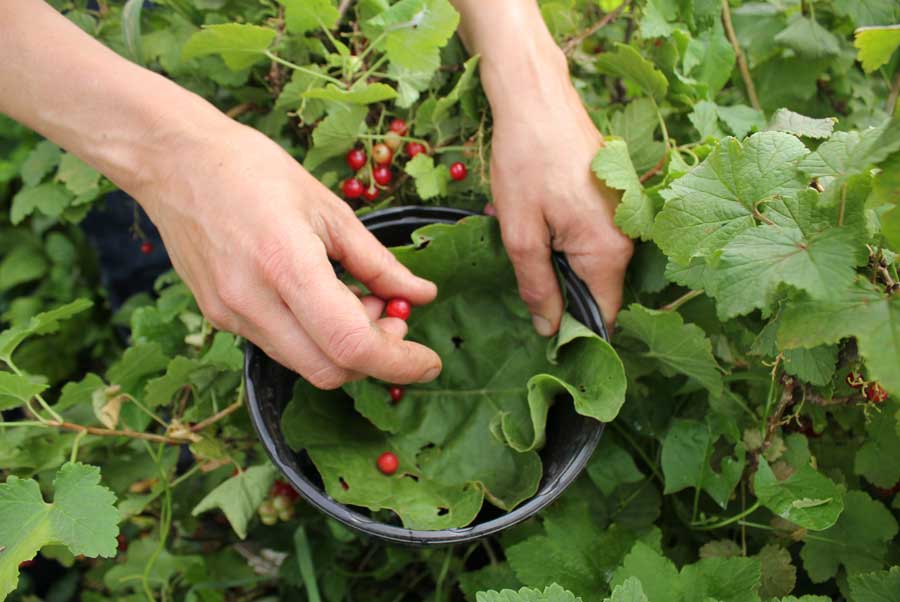
Fruit are formed from late spring though to autumn. Red and white currants are borne in long trusses or ‘sprigs’ each with 10-20 berries. These are often snipped off stems with scissors rather than individual berries being picked off one at a time. You can then use a fork to pull the berries from the ‘sprigs’ when back in the kitchen. Black currants grow in shorter clumps that are easy to snip off stems. Try to harvest in dry weather as wet fruit will deteriorate quickly.
Storage: Freshly picked currants do not keep for long. Best eaten immediately or cooked. Currants can be frozen for use in cooking or preserving at a later date. Spread them out on plates or trays in the freezer until frozen and store in bags.
Pruning
Black currants produce fruit on stems that have grown in the previous couple of years. If you are planting them during the winter months then all stems can be cut back to two buds from their base so plants look like a collection of small stumps. This can be a little scary to do if you are not used to such radical actions but these stumps will soon grow into new stems. The idea of this drastic hard cutting back is to stimulate production of strong healthy stems. You won’t get any fruit in the first year but subsequent years should reward you well. No more pruning happens for two summers until in the second winter you cut out up to a quarter of the stems – chose the older ones. This ‘quarter’ prune is repeated thereafter every winter – as a general rule, plants should be restricted to 9 or 10 stems.
Red and white currants produce fruit on stems that have been growing for two to three years. Pruning aims to create a healthy framework that is geared to good fruit production. Plants are pruned to form an open, goblet-shape that allows good airflow and lets light into the centre. It is a bit technical but should make sense if you only apply each step at the recommended time.
After planting, pull off any shoots – or suckers – that are growing from beneath the soil. Cut back to the main stem any lower side branches so the main stem is clear for about a finger’s length from ground level. This will give your plant a short leg or ‘stool’. Cut back all remaining branches to a third of their original length, making your cuts just above an outward facing bud. Thereafter, pruning takes place in summer as soon as fruit have been harvested. All side shoots are cut back to 5 leaves from their base. When the upwards-growing main stems that form the goblet shape have reached the height you want for your currant bush, cut them back in the same way to 5 leaves from their base. Repeat this every summer.
Pests
If you get their growing conditions right currants should be trouble free. They are susceptible to mildew where they dry out in summer and aphids can be a problem at the tips of soft young shoots. In winter hungry birds eat the young developing buds and they’ll also strip plants of ripe fruit in summer. Cover with bird mesh or grow currants with other berry fruits in a fruit cage.