




Elder
Grow
Sambucus nigra
Elder trees have a long association with gardens. They grow quickly with a rippled corky bark and form small to medium-sized trees. Across Europe, where they are often considered a weed, elder trees are found in woodland margins, along hedgerows and throughout suburban wasteland. Elders are shrouded in religious meaning – historically they were planted near dwellings to ward off evil. Nowadays elder trees offer two main attractions, one being the clusters of almost black berries that ripen in late summer and the other being the heavily fragrant umbels of white flowers that precede them in spring. They are frost tolerant, their leaves fall in autumn and leave trees are bare until early spring when new shoots burst from stems. Flowers and ripe berries can be made into wines, champagne, cordials, teas puddings, jellies and jams.
The most common variety is European elder ‘Sambucus nigra’.
In a nutshell
- Medium sized trees
- Need fertile soil with good drainage
- Fast growing
- Harvest flowers and berries
Quantity
1 tree per household
Companions
- Garlic
- Comfrey
- Borage
- Dill
- Chives
- Nasturtium

The growing lifecycle
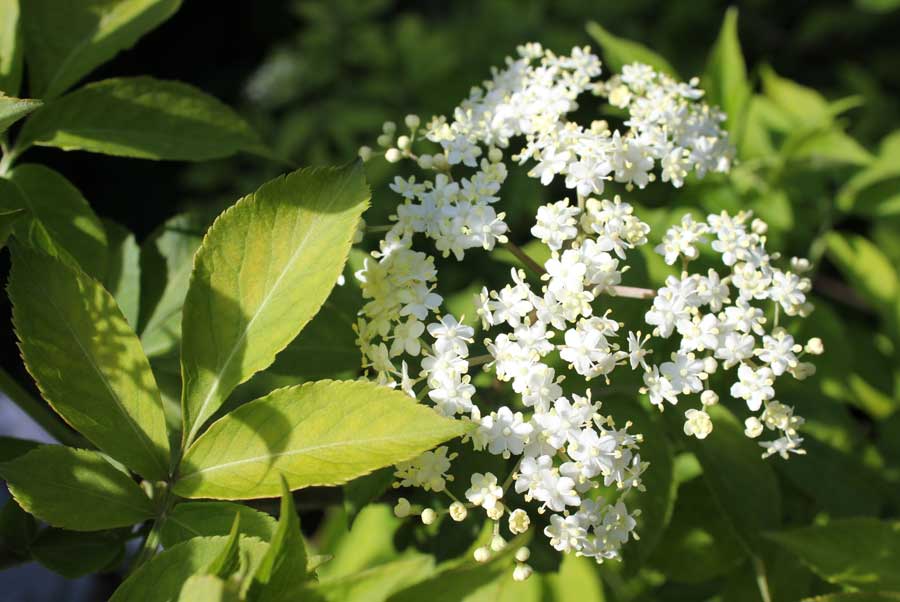
An 'umbel' - or cluster - of Elder flowers

An 'umbel' - or cluster - of Elder flowers

A cluster of ripe Elder berries
Getting started
When
You can buy both bare root and container grown Elder saplings. Bare root saplings are often much cheaper but less advanced.
Plants grown in containers are sold year round and can be planted whenever. However, they do best when planted between autumn and spring as this gives them a chance to establish themselves before the drier summers.
Bare root Elder saplings are only sold between November and March. Normally they are planted out immediately.
Where
Elder trees like a sunny spot with some protection from harsh midday sun that can burn their delicate leaves. They grow well in partial shade. Trees can grow as tall as a two storey house but size can easily be regulated by cutting them back (see pruning).
Soil
Elder trees are not particularly fussy. They will grow on most soils but prefer it if soil holds a little moisture and contains some organic material. They naturally grow in places with a lot of leaf litter on the ground so this can easily be replicated with mulch.
Planting
Plant
Soak container grown Elder before planting.
Prepare the ground. Dig through the planting area to about a spade’s depth and remove all weeds. Add well rotted manure and leaf mould or compost to soil and mix well. Make a hole about 20% larger than the size of the container the plant comes in, or large enough for a bare root sapling to spread its roots out. Gently remove container grown plants from their container. Stand the root ball in the hole and adjust soil beneath it so that the top of the root ball is an inch below the ground level. Backfill with the soil/compost mix and firm with downward hand-pressure as you go. Water well.
Maintain
Water around the base of your young trees in dry periods, making sure that soil gets enough water for roots to be fully soaked. Mulch around the base of newly-planted trees, especially if you have sandy soil. Cover a circle as wide as the spread of the branches with a finger-deep layer of compost, rotted manure or old straw and replenish mulch when necessary. Make sure the mulching layer doesn’t touch the stem of your tree as this can cause it to rot. This should be done for the first three years after planting,
Feed: Elder trees don’t need too much in the way of feeding and may produce heaps of soft, weak growth if they are overfed. Keeping the ground beneath your trees weed-free and well-mulched when its dry should help to reduce the amount of feeding that is required. Trees can be fed with a sprinkling of blood and bone meal around the outer edge of their drip line (widest edge of outer branches) in early spring. Scatter untreated wood ash on the ground beneath them in spring to boost flower and fruit production.
Elders are not the tidiest looking trees and stems can soar at odd angles, they can be pruned to maintain a good framework of healthy branches. Cutting back old stems can help to stimulate fresh growth of fast growing new shoots and foliage but it will interrupt flowering and therefore subsequent fruiting – perhaps for a season. For maximum produce, just prune lightly – removing any damaged, diseased and dead wood. When you remove branches or stems that are growing from the base of the tree they should be cut right back to the point where they start growing. Trees will shoot vigorously from the point where they were cut and if this is too far up a branch then you may end up with a lot of new growth at a point where it makes the tree top heavy and weak. If a tree is particularly unruly, badly damaged or has become unproductive then you can cut the whole thing back to a stump. It will re-grow even from such drastic pruning.
Harvest or pick
Flowers are produced in early summer. To make cordial or champagne they are best picked on a dry sunny day. Take flowers from several trees if you can so that berries can still be plentiful on each tree later in the year. Flowers can be cut in their crowded umbels and then removed from the stems with a fork – just pull the tiny blooms away and the stems will be mostly left behind. The berries ripen in late summer. They are bitter unless fully ripe and even then they have a perky tartness to them. Snip bunches of berries with scissors or secateurs.
Storage: Elder berries can be frozen in bags. Place unwashed berries on trays or plates and freeze. Store them in bags or old ice cream tubs. The berries will collapse on defrosting so best used for cooking, making cordial or preserving.
Pests
Given the right growing conditions elder should be problem free. They do sometimes have problems with aphids that crowd their soft new growing tips. Spray aphids with Neem oil, garlic or tomato leaf spray. On a large tree this may be impractical, best thing to do is encourage predatory insects like hoverflies, ladybugs and lacewings into your garden with companion flowers.